Iteru’s Solution
Proof of Concept Platform
Iteru has completed a proof of concept platform to validate its core concepts leading to.
- Building accurate proprietary AI algorithms.
- Improve the quality of biomedical data.
- Attain scalability of 1 petabyte.
- Integrate all non-multimodal and multimodal in a single data lake.
- Implement classification algorithms.
- Providing automated data labeling to isolate data related to analysis.
In addition to pharma R&D, the platform’s scalability and ability to access and integrate all data types provide a paradigm for digitizing applications such as patient care, document management, and security.
AI Data Analysis
The proof of concept platform applies AI (NLP) and proprietary algorithms to determine the association of cancer with biological entities. Dimensionality is reduced to visualize results in 3-D. It allows a researcher to expedite pharma R&D by identifying new targets, investigating toxicity, efficacy, drug repurposing and different aspects of pharma R&D. Interactive tools allow the researcher to tune parameters that impact the results, enabling him/her to gain more understanding of the disease and obtain actionable results. Examples of data analysis are provided below.
The Wide Scope of the Platform
The biggest impediments to drug discovery, pharma digitization and other aspects of pharma R&D are: scalability, difficulty of integrating non-multimodal and multimodal data, lack of effective data cleansing and inaccessibility of data stored in silos. These are formidable problems for which only partial solutions exist. Iteru provides an elegant and complete solution. The product is scalable to 1 petabyte. The figure below shows a rudimentary block diagram of the platform. Starting at the left-hand side, biomedical data, both multimodal and non-multimodal is integrated into a data lake, labelled and preprocessed.
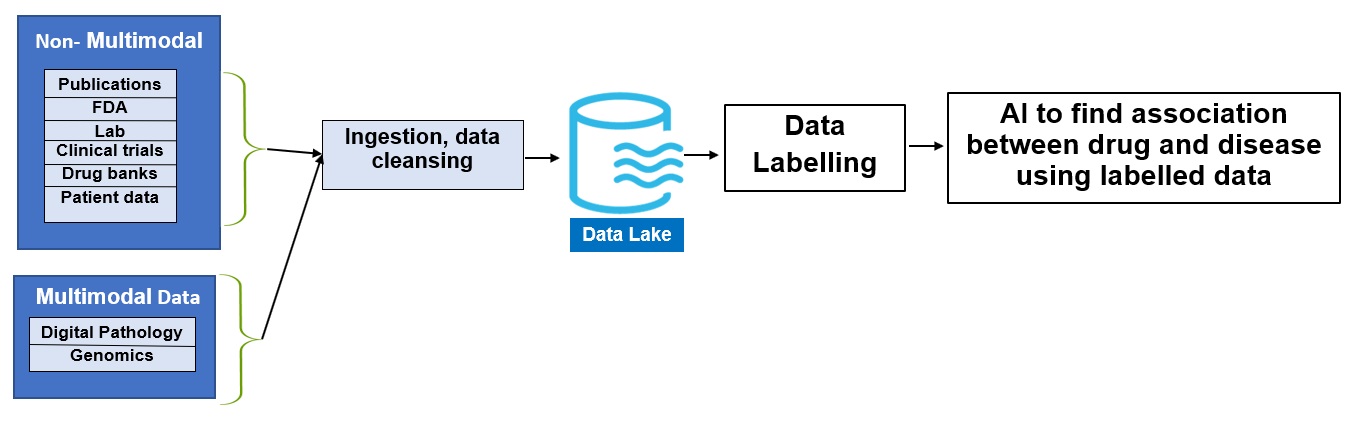
A block diagram of Iteru’s Platform
Beyond pharmaceutical R&D, the platform addresses broader digitization needs, including clinical development, data governance, advanced analytics, patient care, document management, and enhanced data security. To support these additional clinical and operational areas, the platform must ingest a wider variety of data types. Currently, the platform extracts document attributes such as permissions, ownership, and access timestamps. This information can be utilized by customers’ security and compliance software.