Iteru Provides Proven Technology
Why we are different?
Until now, the success of AI drug discovery has been constrained by poor accuracy. Iteru addresses this challenge directly, delivering measurable, verifiable validation at multiple stages of the AI analysis
Quantification of Accuracy
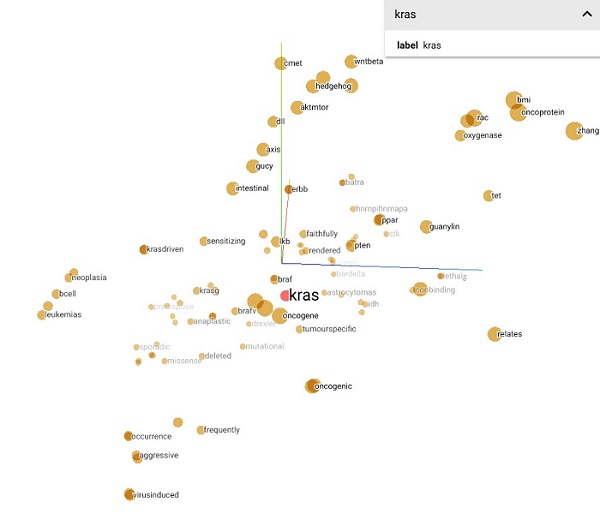
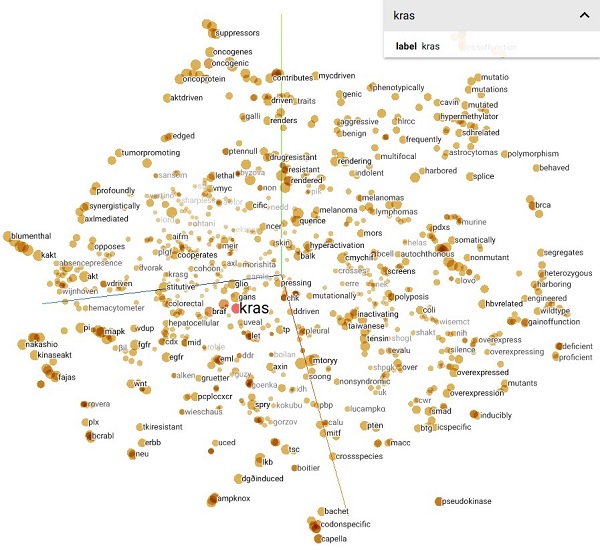
Accuracy is a core priority for Iteru. At each step of its initial AI analysis, data cleansing, and preprocessing, the platform measures the precision of biomedical entity extraction. These entities include disease-associated factors such as oncogenes, proteins, pathways, receptors, etc. Algorithms measure changes in entity frequency. Iteru targeted 90% accuracy. To validate this, the algorithms were tested in a controlled environment against measured biomedical entities. The two figures below compare the extracted biomedical entities before and after data preprocessing. Post-cleansing, there is a pronounced increase in the total number of entities, moving closer to the target of 90% extraction accuracy.
Biomedical data: before Cleansing
Biomedical data: after Cleansing
How the Proof of Concept is Used
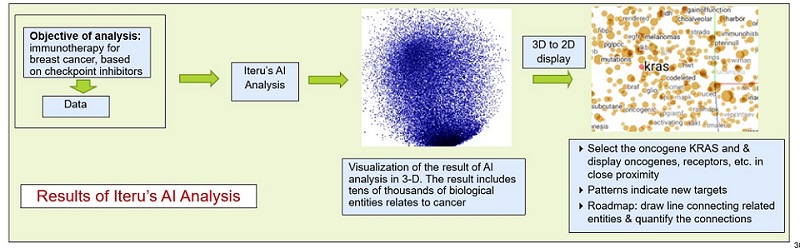
The figure below illustrates the workflow for Iteru’s AI Platform. On the left side, a scientist specifies the objective of the analysis. Here, the objective is immunotherapy for breast cancer. The software extracts related data from the data lake, cleanses and labels it. It is preprocessed into a format suitable for AI, which extracts relationships between diseases and biomedical entities, as well as among the entities themselves. Users can view results in a text, table, or 3D format, and select a specific disease or entity directly from the interface. The selected item is displayed in block letters and other entities are displayed around it based on proximity. In the top right-hand corner, KRAS was selected. Scientists can choose any entity or disease to investigate its associations, strengthening their findings through a statistical analysis of spatial proximity and interactions between them.